-
Sanctions and the War on Meaning: A Civilizational Perspective on Western Coercion
Author: Peiman Salehi*
*Originally published on: geopolitika.ruIn 2025, sanctions have evolved beyond being mere instruments of economic pressure. They have become tools of civilizational warfare—targeting not only material capacities, but also the symbolic foundations, cultural identities, and political legitimacy of non-Western societies. What was once labeled “maximum pressure” is now more accurately a form of epistemic aggression, where the goal is not simply regime change but the erosion of civilizational selfhood. This commentary argues that sanctions today form part of a broader ideological offensive aimed at preserving Western hegemony in an increasingly multipolar and culturally diverse global order.
From Syria to Sub-Saharan Africa: Sanctions as Civilizational Punishment
In December 2024, the Assad regime fell, and Syria entered a transitional phase, with Ahmad al-Shar’a—former leader of Hay’at Tahrir al-Sham—declared interim president. However, this power shift did not result in the easing of sanctions. Instead, it revealed a deeper logic behind sanctions: they are not merely directed at specific regimes, but at broader principles of autonomy, resistance, and rejection of Western dependency.
In Iran, although diplomatic talks took place in April 2025 between Iranian Foreign Minister Abbas Araghchi and U.S. envoy Steven Witkoff in Muscat, no meaningful signs of sanctions relief have emerged. This suggests that the issue is not simply policy-related, but civilizational. For the United States, Iran and its ideological allies in the Resistance Axis represent a challenge not just to political norms but to the liberal international order itself. Consequently, a lasting agreement with Iran appears unlikely—unless Iran undergoes a profound transformation in identity and worldview.
In Palestine, sanctions and blockades intensified after 2024, targeting not only resistance groups like Hamas and Islamic Jihad but also the broader infrastructure of sovereignty in Gaza. These measures are less about security and more about breaking the symbolic backbone of resistance. Similar patterns can be observed in Sub-Saharan Africa, where countries like Zimbabwe, Mali, and South Sudan are sanctioned ostensibly for governance failures, but in truth for defying liberal developmental orthodoxy.
Neocolonialism Repackaged: Sanctions as Symbolic Violence
Sanctions today serve as more than coercive tools—they act as neocolonial instruments of moral and symbolic control. They operate through a form of symbolic violence, delegitimizing alternative value systems by controlling access not only to economic resources, but also to cultural production, digital infrastructure, and epistemic platforms. From banning books and freezing academic exchanges to demonizing defiant identities in global media, sanctions monopolize the authority to define reality. In this way, they function as an assault on meaning itself—a strategy to make resistance appear irrational, illegitimate, or obsolete.
Why Liberal Empires Fear Cultural ResistanceThe liberal international order, increasingly devoid of moral coherence, no longer fears armies—it fears narratives. States and movements that question the epistemological supremacy of the West—whether in Iran, Venezuela, Russia, or Palestine—are seen not only as political threats but as civilizational anomalies. Sanctions are thus deployed as preemptive strikes—not for what these actors do, but for what they are. They represent ontological warfare, targeting the being and symbolic presence of civilizations that propose different visions of law, justice, and world order.
What Resistance Requires: Reclaiming the Language of Sovereignty
Confronting sanctions requires more than policy reforms or economic resilience. It demands epistemic resistance—the ability to define, frame, and narrate one’s reality independently of Western scripting. This involves reclaiming the language of morality, sovereignty, and dignity. The Global South must counter sanctions not only with material strategies, but with a coherent civilizational identity that denies the West its exclusive right to define what constitutes legitimacy, progress, or human value. Narrative sovereignty is not a luxury—it is a prerequisite for geopolitical independence.
Conclusion: Sanctions in the Age of Postmodern Empire
In 2025, sanctions have become instruments of postmodern imperialism. They no longer merely starve economies; they aim to strip cultures of meaning, reduce sovereign states to managed zones, and normalize a world in which only liberal narratives are allowed to survive. Understanding sanctions as civilizational warfare is the first step toward resisting them—not only with economic policy, but with cultural confidence, moral clarity, and strategic storytelling.
-
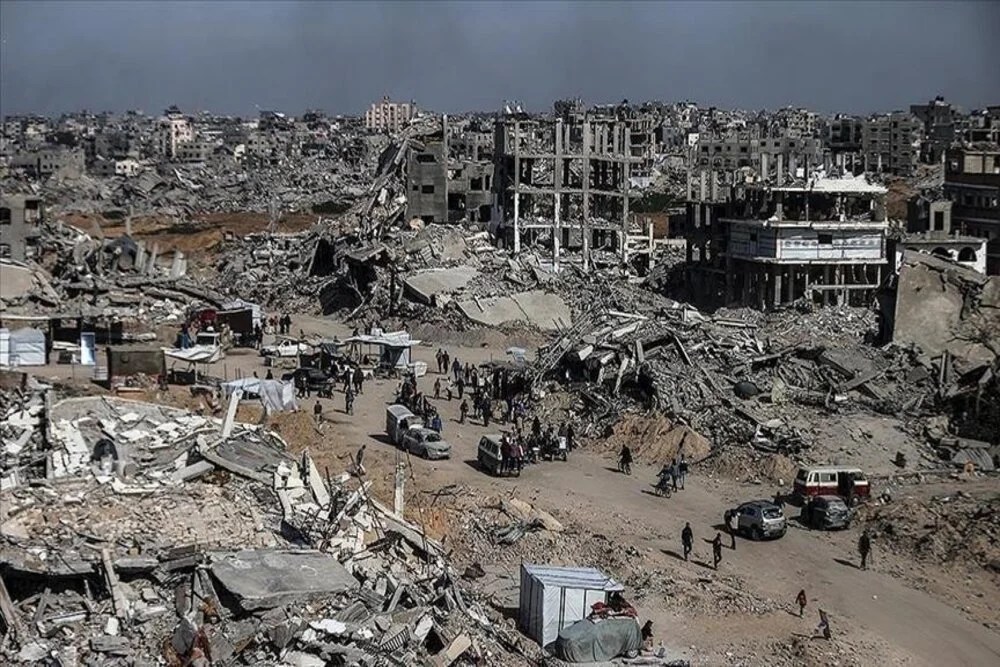
Human Rights Or A Political Tool? The West’s Contradictions On The Gaza Ceasefire
Author: Peiman Salehi*
*Originally published on: Oriental ReviewIn recent days, the world has once again witnessed Israel’s blatant violation of the ceasefire and the assassination of several Hamas commanders. These attacks, while the United States and its Western allies consistently proclaim their commitment to peace and human rights, are yet another example of the double standards applied in international affairs. These contradictions raise fundamental questions about the political philosophy governing the global order.
John Locke, the renowned political philosopher, once wrote: “Freedom only makes sense when accompanied by justice.” But how can one speak of freedom and justice when the West remains silent in the face of Israel’s crimes? If the war in Ukraine is considered an attack on the “international order,” why are Israel’s relentless attacks on Palestinian civilians ignored?
The United States has long presented itself as a champion of democratic values, yet in practice, human rights only hold significance in its foreign policy when they align with American interests. Henry Kissinger once stated: “There are no permanent enemies and no permanent friends, only permanent interests.” This approach has fostered a dual policy in which some nations are subjected to sanctions and pressure under the pretext of “human rights violations,” while U.S. allies, even when committing blatant crimes, remain immune from any consequences.
This issue is not limited to Palestine but extends to many other regions. Military interventions in Libya and Iraq, support for armed groups in Syria, and the double standards in addressing humanitarian crises all exemplify a policy where ethical principles are ignored in favor of geopolitical interests. Noam Chomsky, the American intellectual, once noted: “Western moral standards have a strange flexibility; when enemies make mistakes, they are intolerable, but when friends do the same, they are overlooked.”
A New Global Order and the Decline of Western Hegemony
Meanwhile, Israel’s ongoing attacks and the West’s unwavering support not only escalate tensions in the Middle East but also undermine the United States’ position as a neutral mediator in international conflicts. Emerging powers such as China and Russia are seizing this opportunity to expand their influence among Arab and Islamic nations. The global order is shifting, and the West’s double standards are only accelerating its declining credibility on the international stage.
Many analysts argue that these contradictions are hastening the decline of Western influence. In recent years, independent-minded states in the region, including Iran, Turkey, and the Gulf Cooperation Council countries, have been reassessing their relations with Washington. Even Saudi Arabia, which was deeply dependent on the United States until recently, is now strengthening its ties with China and Russia. This shift in approach indicates that even America’s traditional allies are losing trust in its inconsistent policies.
Human Rights or a Political Pressure Tool?
Ultimately, the key question remains: Isn’t it time for genuine human rights standards to be defined based on justice and universal principles, rather than the interests of great powers?
How can a global system claim to uphold order and justice while selectively ignoring some crimes and imposing severe sanctions on others?
If the West is truly committed to democracy and human rights, it must apply these principles universally, rather than using them as a geopolitical tool. As long as these contradictions persist, global peace and security will remain increasingly fragile, and the West’s legitimacy in defending human rights will continue to be questioned.
-
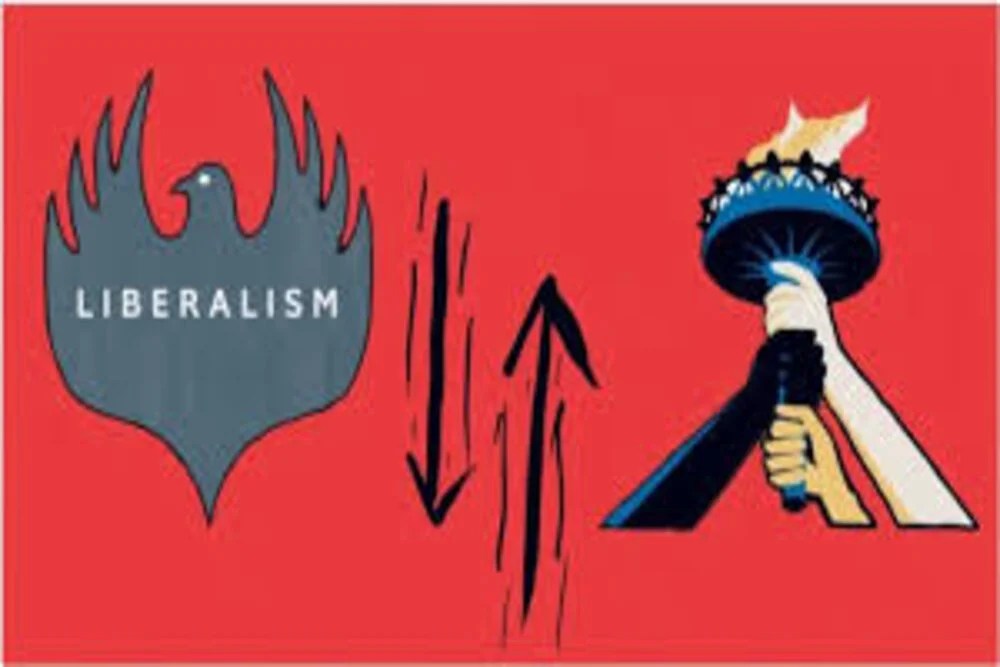
The Ukraine War As A Turning Point: The Rise Of A New Ideological Challenge To Liberalism
Author: Peiman Salehi*
*Originally published on: Oriental ReviewSince the collapse of the Soviet Union, the United States and its Western allies have sought to consolidate a unipolar world order based on liberal democratic values and free-market capitalism. This vision was famously articulated by Francis Fukuyama in The End of History and the Last Man (1992), where he argued that liberal democracy had emerged as the ultimate form of governance. However, three decades later, the global landscape tells a different story—one where the limitations and contradictions of liberalism are increasingly evident, and new ideological and geopolitical forces are reshaping the international order.
The Ukraine war has emerged as a pivotal moment in this transformation. What began as a geopolitical conflict has exposed deeper fractures in the Western-led order, highlighting the disparity between the ideological rhetoric of liberalism and the pragmatic realities of global power politics. Today, we are witnessing the rise of a post-liberal paradigm that challenges the core assumptions of Western dominance, led by an emerging alliance between Russia, China, and Iran.
From Unipolarity to Strategic Disillusionment
When Russia launched its military operation in Ukraine in 2022, the West responded with a unified front of sanctions, military aid to Kyiv, and diplomatic isolation of Moscow. The expectation in Washington and Brussels was clear: Russia would collapse under economic pressure, Vladimir Putin’s regime would face internal unrest, and the liberal democratic model would once again prove its superiority. However, after more than three years of war, these expectations have not materialized. Instead:
- The Russian economy has adapted to sanctions, forging deeper economic ties with China, India, and the Global South.
- The Ukrainian counteroffensive has failed to achieve its intended objectives, and U.S. officials are now pressuring Kyiv to enter negotiations with Moscow.
- European unity has begun to fracture, with increasing opposition to continued military aid and economic sacrifices.
In essence, the Ukraine war has become a moment of strategic disillusionment for the West. It has demonstrated that the United States can no longer dictate global outcomes as it once did, and that even longtime allies are beginning to hedge their bets against the waning hegemony of the liberal order.
The Crisis of Liberal Ideology: When Pragmatism Overrules Principle
One of the most striking aspects of the Ukraine conflict has been the way it has exposed the contradictions within Western liberalism. The United States, which has long positioned itself as the defender of democracy and sovereignty, has repeatedly sacrificed its stated values for strategic interests:
- The withdrawal from Afghanistan in 2021, where Washington abandoned its allies after two decades of war, raised questions about its reliability.
- The handling of Ukraine, where U.S. officials encouraged resistance against Russia but are now considering forcing Kyiv into a peace deal, reflects a transactional approach to alliances.
- The Gaza conflict, where Western support for Israel has remained unwavering despite massive civilian casualties, exposes the selective application of human rights principles.
This inconsistency has not gone unnoticed. Countries that were once staunchly aligned with the U.S., such as Saudi Arabia, have adopted more independent foreign policies, refusing to fully comply with Western-led sanctions against Russia and maintaining economic ties with China.
The erosion of trust in liberal internationalism is not just a matter of policy miscalculations—it is a fundamental crisis of legitimacy. As John Mearsheimer, a prominent realist scholar, argues, “Liberal hegemony is unsustainable in a world where states prioritize survival over ideological conformity” (Mearsheimer, 2022). The era when the U.S. could shape the world in its image through moral persuasion alone is coming to an end.
The Rise of a New Ideological and Strategic Axis
While the West grapples with internal divisions and declining influence, an alternative global framework is emerging. Unlike the Cold War, where the world was divided between capitalism and communism, today’s ideological contest is more complex. The rising powers—Russia, China, and Iran—do not share a single ideology, but they are united in their opposition to a U.S.-dominated order. Their challenge is based on:
- Economic Sovereignty – China’s Belt and Road Initiative and de-dollarization efforts are undermining U.S. financial dominance.
- Security Realignment – Russia’s military assertiveness has defied NATO expansion, reshaping the European security architecture.
- Diplomatic Multipolarity – Iran’s strategic partnerships, including its reconciliation with Saudi Arabia, indicate a shift away from U.S.-mediated alliances.
Each of these elements contributes to the formation of a post-liberal, multipolar world. As Wang Hui, a Chinese scholar of global politics, notes, “The West no longer holds a monopoly on defining modernity—alternative models of governance are emerging from the non-Western world” (Hui, 2021).
The Future of Global Order: A Post-Liberal Era?
The key question that arises from these shifts is whether the world is truly entering a post-liberal era. Will liberalism adapt once again, as it has in past crises, or is this the beginning of its irreversible decline?
There are three possible scenarios:
- Adaptation and Survival – Liberalism, despite its contradictions, has historically been flexible. It may evolve to accommodate multipolarity rather than resisting it outright.
- Fragmentation and Decline – If internal divisions in the West continue and emerging powers solidify their alternative frameworks, liberalism could fade as the dominant global ideology.
- Ideological Conflict – The current competition between liberal and post-liberal states could escalate into deeper confrontations, leading to prolonged instability.
Regardless of which path unfolds, one thing is clear: history has not ended. The Ukraine war, rather than reaffirming the inevitability of liberal democracy, has marked the beginning of a new chapter—one in which the future of global governance remains deeply contested.
 Peiman Salehi – Political Analyst & Writer