-
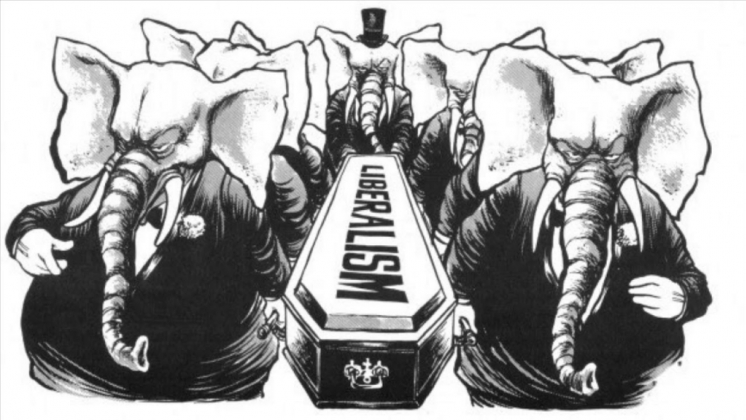
The Betrayal of Liberalism: How the West Abandoned Its Own Ideals
Author: Peiman Salehi*
*Originally published on: Geopolitika.RuLiberalism emerged as a reaction to the oppressive structures of feudalism and absolute monarchy, promising a world where individuals could exercise their freedoms, own property without fear, and live under governments that respected their fundamental rights. Thinkers like John Locke envisioned a society where “life, liberty, and property” were sacred principles, while John Stuart Mill argued that individual happiness and autonomy should be the core of governance. Liberalism, in its classical form, positioned itself as the ideological alternative to authoritarianism, and later, as the ultimate response to Marxism during the Cold War.
Yet, despite its initial promise, the trajectory of liberal states today starkly contradicts the very principles they claim to uphold. In practice, modern liberalism has become a mechanism not for ensuring freedom, but for justifying global inequalities, economic domination, and military interventions that strip entire nations of their sovereignty.
Philosopher Antonio Gramsci once wrote, “Hegemony is maintained not only through force but through the shaping of ideology itself.” Nowhere is this more evident than in the foreign policies of Western liberal democracies, which continue to expand their influence under the guise of spreading “freedom” while ensuring the economic and political subjugation of the Global South.
Liberalism and the Destruction of Sovereignty
The West’s foreign policy has consistently betrayed the foundational liberal idea of self-determination. Locke argued that no authority should govern without the consent of the governed. However, from the Cold War to the present, the United States and its allies have systematically undermined democratically elected governments that oppose Western economic interests.
One need only look at the history of Latin America, where coups in Chile (1973), Argentina (1976), and Brazil (1964) were directly or indirectly supported by liberal states in the name of “defending democracy.” Henry Kissinger, the architect of many such interventions, infamously remarked, “I don’t see why we need to stand by and watch a country go communist due to the irresponsibility of its people.” This statement alone encapsulates the fundamental hypocrisy of Western liberalism—freedom is only tolerated when it aligns with the interests of those in power.
In the contemporary world, we see the same contradictions in Ukraine, where the West claims to defend sovereignty while fueling a war that primarily serves the geopolitical ambitions of NATO rather than the well-being of Ukrainians. Meanwhile, sanctions against countries like Cuba, Venezuela, and Iran are imposed in the name of human rights, while Western allies such as Saudi Arabia remain immune from scrutiny despite their blatant suppression of freedoms.
The Myth of Economic Freedom and Property Rights
If there is one area where liberalism’s contradictions are most glaring, it is in the economy. Adam Smith’s vision of a free-market system was based on the premise that competition would ultimately lead to prosperity for all. Yet, modern neoliberalism has instead concentrated wealth in the hands of a few, turning entire nations into economic colonies of multinational corporations.
The concept of private property, once defended as the foundation of individual freedom, has become a tool for corporate imperialism. John Locke’s idea that “the fruits of one’s labor belong to oneself” is meaningless in a world where resources in Africa, Latin America, and the Middle East are extracted by Western corporations while local populations live in poverty. The irony is undeniable—those who preach the sanctity of private ownership have systematically denied it to the world’s most vulnerable.
The ongoing economic exploitation of the Global South is not an accident—it is a deliberate feature of modern liberal capitalism. Philosopher Noam Chomsky has long argued that “what is called ‘liberalization’ simply means ensuring that wealth and power are concentrated in the hands of a few.” Trade agreements, loan conditions imposed by the IMF, and the manipulation of global supply chains ensure that the so-called “developing world” remains dependent on Western financial institutions, despite decades of supposed economic liberalization.
Freedom: An Illusion in a World of Surveillance and Control
The West’s claim to defend individual freedoms is equally hollow when examined closely. John Stuart Mill, the great advocate of liberty, warned that “the worth of a state, in the long run, is the worth of the individuals composing it.” Yet, modern liberal states have turned surveillance into an everyday reality, criminalizing dissent while justifying mass surveillance in the name of security.
From the U.S. Patriot Act to Europe’s increasingly strict digital monitoring laws, governments that once championed human rights now systematically violate privacy in ways that authoritarian regimes could only dream of. Meanwhile, whistleblowers like Edward Snowden and Julian Assange, who have exposed these contradictions, are treated as enemies rather than defenders of liberty.
At the same time, the rise of corporate control over public discourse—through social media censorship, data manipulation, and monopolization of information—raises serious questions about whether political freedom is anything more than an illusion. As philosopher Slavoj Žižek argues, “Today’s freedom is the freedom to choose between options designed for you.” If an individual’s choices are shaped entirely by corporate algorithms and state propaganda, can we truly call them free?
Conclusion: Can Liberalism Be Redeemed?
The contradictions of modern liberalism have reached a breaking point. What was once a philosophy of freedom has become a tool for subjugation. The liberal world order, which emerged victorious from the Cold War, is now a system that perpetuates global inequalities, suppresses dissent, and prioritizes corporate interests over human dignity.
Yet, the failure of liberalism does not mean that its original ideals were wrong. Perhaps the true betrayal lies not in liberal philosophy itself, but in its implementation by states that have never truly adhered to its principles. The question remains: will liberal societies reform themselves before they collapse under the weight of their contradictions, or will they continue to weaponize freedom while denying it to the very people they claim to protect?
As history has shown, no ideology—no matter how powerful—can sustain itself indefinitely when its foundations are built on hypocrisy.
-
Africa and the Multipolar Moment: Between Non-Alignment and Neo-Colonial Games
Author: Peiman Salehi*
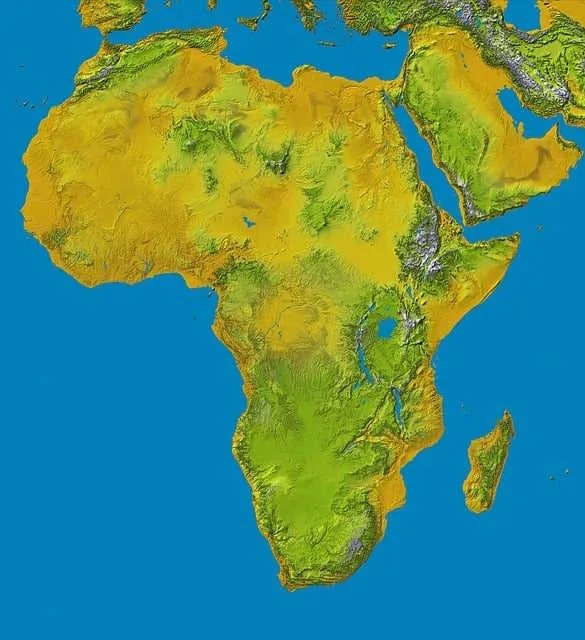
*Originally published on: South Africa TodayAfrica and the Multipolar Moment: Between Non-Alignment and Neo-Colonial Games. Image source: Pixabay
In today’s rapidly shifting global order, Africa finds itself at a critical juncture. The so-called “multipolar moment” presents both an opportunity and a threat. On the one hand, the decline of unipolar dominance creates breathing room for African nations to assert sovereignty, experiment with new alliances, and reimagine their global roles. On the other hand, the same geopolitical transition has revived colonial-era tactics of influence and control, now dressed in the language of aid, investment, and partnership.
The West, particularly the United States and its European allies, no longer holds uncontested sway over African affairs. The rise of China and the reassertion of Russian influence have disrupted traditional alignments. This has led to a new scramble for Africa—not for raw materials alone, but for narrative, leverage, and loyalty.
The Illusion of Non-Alignment
In response to global competition, many African states have resurrected the idea of non-alignment—a strategy once popular during the Cold War. But today’s context is different. The bipolarity of the past has given way to a fragmented and competitive global arena. Non-alignment, in this setting, risks becoming a rhetorical device rather than a genuine strategic posture. Western institutions still demand allegiance through conditional aid, security pacts, and ideological alignment, while Eastern powers offer alternative models with their own expectations.
Neo-Colonialism in New Clothes
The mechanisms of control have evolved. No longer are gunboats or direct rule required. Instead, African economies are being shaped by debt traps, digital surveillance, political influence operations, and media infiltration. Western multinationals dominate supply chains, while global financial institutions prescribe neoliberal reforms that often cripple local industry and undermine state capacity.
Moreover, sanctions imposed on states like Zimbabwe or pressure campaigns against others resisting the liberal orthodoxy demonstrate how sovereignty can be penalized under the guise of “values.” This selective enforcement exposes the moral contradictions within the liberal world order—where freedom is conditional, and independence is negotiable.
The Strategic Value of Africa in the Multipolar Contest
Africa is no longer a passive terrain—it is an active player. The continent holds strategic weight in global institutions, critical mineral resources for the green economy, and demographic leverage with its youthful population. The BRICS+ expansion, growing cooperation with China’s Belt and Road Initiative, and increasing military ties with Russia signal that Africa’s voice in the global conversation is growing louder.
Yet, the danger lies in misreading the moment. Multipolarity does not guarantee justice. It merely shifts the centers of power. If African leaders fail to anchor their policies in self-defined priorities—rooted in cultural dignity, economic sovereignty, and political independence—they risk trading one master for another.
Conclusion: Beyond the Game
Africa must not become the playground for global powers seeking to outmaneuver each other. This is a historic moment for the continent to define itself—not as a buffer zone in a new Cold War, but as a civilizational force with its own worldview. To do so, African states must move beyond tactical balancing and embrace a long-term strategic vision that resists both Western paternalism and Eastern pragmatism when they threaten autonomy.
The future of the global order may well be written in African ink. The question is: who holds the pen?
-
Human rights should apply equally, not only when it pleases the US
Author: Peiman Salehi*
*Originally published on: SCMPFeel strongly about these letters, or any other aspects of the news? Share your views by emailing us your Letter to the Editor at letters@scmp.com or filling in this Google form. Submissions should not exceed 400 words, and must include your full name and address, plus a phone number for verification
The world has once again witnessed Israel’s blatant violation of the Gaza ceasefire and its assassination of Hamas leaders. The lack of condemnation from the United States and other Western allies is yet another example of double standards. If the war in Ukraine is considered an attack on the international order, why are Israel’s relentless attacks on Palestinian civilians ignored?
The US presents itself as a champion of democratic values, yet in practice human rights only hold significance in foreign policy when they align with American interests. Some nations are subjected to sanctions and pressure under the pretext of human rights violations while US allies, even when committing blatant crimes, remain immune from consequences.
And it’s not just Palestine. Military interventions in Libya and Iraq, support for armed groups in Syria and double standards in addressing humanitarian crises all exemplify a policy where ethical principles are ignored in favour of geopolitical interests.
Meanwhile, Israel’s attacks are not only escalating tensions in the Middle East but also undermining America’s position as a neutral mediator in international conflicts. Emerging powers such as China and Russia are seizing this opportunity to expand their influence among Arab and Islamic nations. The global order is shifting, and the West’s double standards are only accelerating decline of their credibility.
In recent years, independent-minded states including Iran, Turkey and Gulf Cooperation Council countries have reassessed relations with Washington. Even Saudi Arabia, which has been deeply dependent on the US, is strengthening ties with China and Russia. America’s traditional allies, it seems, are losing trust in its inconsistent policies.
The key question remains: isn’t it time for human rights standards to be based on justice and universal principles rather than the interests of great powers? How can a global system claim to uphold order and justice when it imposes severe sanctions on some while ignoring the crimes of others?
 Peiman Salehi – Political Analyst & Writer