-
Palestine and the Collapse of the ‘Rules-Based World Order’
Author: Peiman Salehi*
*Originally published on: counterpunch
Photograph by Nathaniel St. Clair
As of May 2025, the humanitarian catastrophe in Gaza has reached an unprecedented level. Over 50,000 Palestinians have been killed since October 2023, the vast majority of them civilians, including thousands of children. Yet, Western powers – particularly the United States and its allies – continue to champion a so-called ‘rules-based international order’. This phrase, often invoked to justify sanctions, interventions, and diplomatic pressure elsewhere, rings hollow when applied to the decades-long plight of the Palestinian people. The ongoing occupation, apartheid policies, and repeated war crimes committed by Israel, backed unconditionally by the West, expose a deep hypocrisy at the heart of this so-called global order.
Despite over 100 UN resolutions condemning Israeli settlements, forced displacement, and indiscriminate attacks on civilians, meaningful accountability remains absent. Israel faces no sanctions, no arms embargo, and no international isolation. Instead, it continues to receive billions of dollars in military aid, preferential trade agreements, and political cover from Western powers. Gaza, meanwhile, remains under siege. Hospitals are bombed, aid convoys are blocked, and basic necessities such as water, fuel, and electricity are deliberately withheld. This is not a security response – it is collective punishment on a mass scale.
The West’s approach to international law is anything but consistent. When Russia annexed Crimea or when countries like Iran and Venezuela were accused of rights violations, swift sanctions and global condemnation followed. Yet, when Israel openly violates the Geneva Conventions, targets civilian infrastructure, and defies the International Court of Justice, it is rewarded with normalisation deals, tech investments, and defence partnerships. This blatant double standard has destroyed the credibility of any ‘rules-based’ narrative. It is clear that the ‘rules’ apply only to adversaries of the West, not its allies.
Equally troubling is the role of Western media in shaping public perception. Palestinian resistance is labelled as ‘terrorism’, while Israeli aggression is framed as ‘self-defence’. Terms like ‘clashes’ are used to obscure the reality of one-sided military assaults. The dehumanisation of Palestinians and the erasure of their suffering are key components of maintaining this illusion of moral superiority. Journalism that challenges this narrative is often silenced, censored, or dismissed as biased.
Palestine is no longer just a humanitarian crisis – it is a mirror reflecting the moral bankruptcy of the global system. The rules-based world order, as promoted by the West, has collapsed under the weight of its own contradictions. When international law is selectively enforced, when some lives are deemed expendable, and when justice is sacrificed for geopolitical interests, what remains is not order, but domination. Justice for Palestine is no longer a political preference; it is a global moral imperative. Until the world confronts this hypocrisy, peace will remain out of reach – not only for Palestinians, but for humanity as a whole.
This article originally appeared in Global Research and was reproduced by Globetrotter.
-
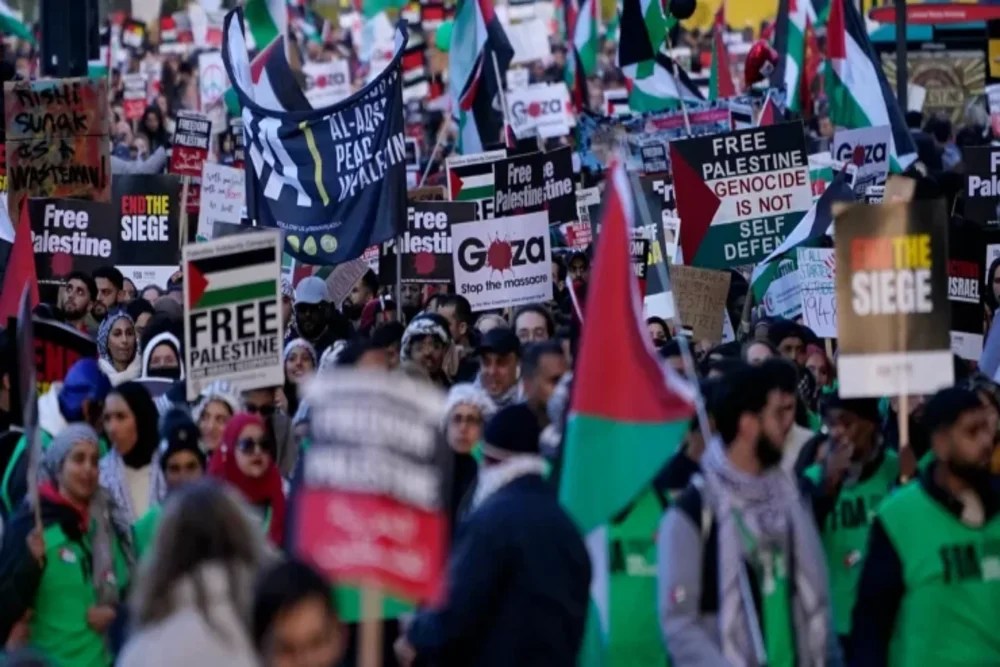
The Palestinian Cause In The Geopolitics Of The Global South
By Martín Martinelli and Peiman Salehi
published on:Docs.Google
The Palestinian resistance is no longer a regional issue; it has become a global symbol of dignity in the face of colonialism and imperial power.
The historical background deeply influences the current situation of genocide and attempts at memoricide, in contrast with the Palestinian popular resistance and global protests aiming to stop it. This context includes centuries of capitalism and the violence inflicted by colonialism and imperialism—through Anglo-Saxon and Western military forces as well as the Israeli army.
One interpretation of the 20th and 21st centuries is how, amidst ongoing colonial projects, African and Asian national liberation movements emerged during the Great European War (1914–1945). The 1950s and 1960s marked a revolution in global energy systems.
Oil became the world’s dominant fossil fuel, surpassing coal and other sources. “Black gold” powered post-war capitalism thanks to its energy density, chemical flexibility, and ease of transport, spurring new technologies and industries. The oil transition and the rise of American power shifted the center of gravity in Afro-Eurasia.
Meanwhile, colonial powers weakened, and newly formed or developing organizations emerged to drive Asia and Africa’s great emancipation in the second half of the 20th century. This occurred within the context of hegemonic blocs—socialist and capitalist—and non-aligned efforts such as the Bandung Conference (1955).
These global transformations continued through revolts, revolutions, and the emergence of new states during the Cold War—some backed by the USSR, others influenced by imperial powers like the U.S., Britain, and France, each with differing decolonization methods.
Major events challenge Eurocentric narratives of history when viewed from other geographies: the Berlin Conference (1884), decolonization (1960s), India’s independence (1947), China’s revolution (1949), and the Russian Revolution (1917). These events shaped the modern century.
China’s 1949 revolution paved the way for the 21st century, followed by the Korean War (1950–1953) and Vietnam’s wars of resistance (1960–1975). In Latin America, movements like the Mexican Revolution (1910–1917) and the Cuban Revolution (1959) transformed national trajectories and global consciousness.
These cultural and civilizational specificities reject simplistic theories like the “clash of civilizations” or the unipolar narrative of Francis Fukuyama’s “end of history.”
Seen from the Global South, where great decolonization processes took place, the bipolar Cold War logic doesn’t fit. These were not “backward” nations, but societies with their own Afro-Asian historical legacies that transcended Western nation-state constructs.
The expulsion and oppression of Palestinians reawaken the historical traumas of transatlantic slavery and colonial genocide. The goal: to erase a people and their homeland to secure imperial interests—especially U.S.-led—tied to oil, gas, and land along Gaza’s coast.
Decades of information control stigmatized Palestinians within the “clash of civilizations” and the “war on terror.” Such narratives dehumanize their political and military resistance.
Hamas, a political, social, and guerrilla organization with Islamic roots, primarily seeks liberation from colonial occupation. Its leaders—often targeted and killed—are children of refugees expelled in 1948.
Understanding the crisis is impossible without analyzing U.S. support for Israel. Since 2013–2014, and especially after February 2022, U.S. power has relatively declined—particularly in Eurasia.
Conflicts like Ukraine overlap with Israel’s military escalation in Syria, Yemen, and Iran. Middle East control relates to global trade routes and regional powers like Saudi Arabia, Turkey, and Iran. The BRICS+ group (Brazil, Russia, India, China, South Africa, plus Egypt, Iran, Ethiopia, UAE, Indonesia) also plays a growing role—especially South Africa.
Palestinian resistance is now a universal symbol of dignity. Gaza—an open-air prison—is the ethical and political epicenter of the Global South’s struggles. Here converge the crises of the modern world: neoliberal decay, militarized imperialism, structural racism, and environmental collapse.
The genocidal images—bombed hospitals, mutilated children, razed neighborhoods—expose not just war crimes but the hypocrisy of liberal world order. The UN, EU, and Western media have failed to stop this machinery of death.
In response, a new internationalism from below emerges, linking Palestine to wider struggles in Asia, Africa, and Latin America.
The Resistance Axis—while not a NATO-like alliance—plays a key role in Palestine. This decentralized network of states and movements across West Asia, Africa, and the Global South unites not by bureaucracy but by shared histories of resistance. Vietnam, Algeria, Cuba, Iran, Yemen—all resisted Western impositions.
Despite attempts to dismantle it—like Syria’s war, the assassination of Qassem Soleimani (2020), or targeted leaders like Haniyeh (2024), Nasrallah, and Sinwar—the resistance endures due to its decentralized and grassroots nature. Yemen’s Ansarallah, for instance, is now seen as a major military actor capable of challenging Israel, viewed as imperialism’s military arm in Afro-Eurasia.
This axis seeks not just territorial defense, but to counter U.S.-Israeli plans for “managed chaos,” fragmentation, and military occupation. In this scheme, Palestine is not merely a victim—it is the strategic rupture point blocking full execution of these plans. Yet recent escalations in Gaza, Lebanon, and Syria pose serious challenges.
Latin America also has a crucial role. The subordination of governments like Javier Milei’s in Argentina—total allegiance to Israel, disregard for international law, and attacks on critical culture—proves that the fight for Palestine also takes place in Buenos Aires, Lima, and Bogotá. To defend Palestine is to defend our universities, unions, and social rights.
Thus, we must build bridges between our resistances. The streets of Caracas, the favelas of São Paulo, the classrooms of Havana, the indigenous movements of Bolivia—they all share deep common ground with Gaza. This new internationalism is not declared at summits—it is built in solidarity, education, decolonial thought, and cultural insurgency.
Palestine is not alone. And neither are we. As intellectuals of the Global South, choosing a side today is not an abstract moral act but a political stance.
Gaza challenges us, because the future of the world is being shaped there: a future of technological barbarism and racial supremacy—or one based on dignity, justice, and self-determination.
In the early days of Israel’s unprecedented attacks on Gaza, Iranian Supreme Leader Ayatollah Ali Khamenei stated, in October 2023, a sharp but clear sentence that exposed one of the century’s greatest lies: Israel’s self-victimization.
A phrase that reversed the media storm of “Operation Al-Aqsa Flood” and awakened many dormant consciences.
Today, Israel’s constructed victimhood is buried beneath the rubble of dead children, mourning mothers, and destroyed hospitals.
Faced with this historic injustice, voices rise from every corner of the world—from Tehran and Beirut to Baghdad, from Johannesburg to Buenos Aires, from Havana to Amsterdam—crying in unison: No to genocide.
Today, every human being who believes in justice—regardless of religion, creed, or border—is on the side of the Palestinian people.
This transnational and transcultural unity shows that resistance is not just a political choice—it is an ethical response to our era’s civilizational decline.
Israel’s conduct contradicts both Judaism’s religious tradition and liberalism’s ethical foundations.
True Judaism upholds justice, compassion, and reverence for human life. It offers no justification for killing children or besieging hospitals. Meanwhile, moral philosophy—especially Kantian ethics—states that human beings must never be treated as means to an end.
Kant, the 18th-century German philosopher, wrote:
“Humanity must always be treated as an end in itself, never as a means.”Yet in Gaza, people are being turned into instruments of political and racial blackmail.
John Locke, father of political liberalism, spoke of three natural rights:
“Life, liberty, and property.”
Rights which Israel has denied not only to Palestinians—but to humanity itself.Our question to Tel Aviv’s leaders is this:
On what principle, philosophy, or conscience do you continue the massacres?You reject UN Security Council resolutions, ignore International Court of Justice rulings, and dismiss the will of global public opinion.
Today, Israel not only violates human rights—it embodies moral disorder in the international system.
This is a crisis of civilization.
-

Sanctions as Civilizational Warfare: A War Without Guns, A War Against Lives
Author: Peiman Salehi
Originally published on:opEDNewsIn a hospital ward in Tehran, a nurse quietly adjusts the makeshift bandage of a young girl suffering from epidermolysis bullosa– an incurable condition also known as “butterfly disease.” The child winces, not only from pain but from the awareness that the specialized dressings she needs no longer arrive. They’ve been blocked– not by medical shortages or supply chain delays– but by economic sanctions imposed on Iran that have restricted access to critical medical imports (click here) .
This girl is not alone. Across Iran and other sanctioned nations, the faces of such children are hidden behind statistics and headlines, if they appear at all. The logic behind their suffering is often called diplomacy. But in reality, it is something more enduring, more silent, and more insidious: a form of civilizational warfare, where policy is weaponized not to change governments– but to break societies.
Sanctions are often described in Western capitals as alternatives to war. They are said to “pressure regimes” and avoid bloodshed. But this language sanitizes their true effect. Sanctions are not abstract levers. They are embodied policies. They invade homes, empty pharmacies, and paralyze hospitals. They transform everyday items– bandages, insulin, chemotherapy drugs– into political bargaining chips (click here).
And while no missiles fly, the casualties are real. A mother unable to obtain seizure medication for her child; a father forced to choose between food and fuel due to inflation driven by financial isolation. These are not collateral damages. They are the primary effects of a system that sees pressure as power, and suffering as strategy.
Iran is a prominent case, but not a unique one. In Venezuela, U.S. sanctions have contributed to widespread malnutrition and medical collapse (Click Here/). In Cuba, a decades-long embargo has stunted the growth of generations, especially in access to pediatric cancer treatment (Click Here). In Syria and Yemen, sanctions and blockades continue to kill silently even after the bombs stop falling (Click Here/).
What binds these nations is not a shared ideology or alignment– but their distance from the dominant geopolitical order. Sanctions, once tools of statecraft, have evolved into a system of punishment for global disobedience. They remind the world who defines the rules of legitimacy– and who pays the price for stepping outside them.
This reality becomes even more jarring when viewed through the lens of Western liberalism. The liberal tradition proclaims universal rights: to life, liberty, dignity. But when those rights are denied on the basis of nationality, how universal are they?
Would John Locke, the father of liberal thought, condone denying children access to life-saving medicine because of where they were born? Would Adam Smith, defender of free markets, accept a world where oil cannot be sold and basic imports are blocked– not because of demand or supply, but because of a hegemonic decision? Would Immanuel Kant, who believed every human must be treated as an end in themselves, tolerate a regime where human beings are reduced to means– to political leverage?
The moral foundations of liberalism crumble when applied selectively. And yet, the very powers that claim moral authority from these philosophies often trample them in practice (Click Here).
Western media plays a subtle but critical role in this civilizational dynamic. When tragedy strikes in Europe or among Western allies, images and stories dominate headlines. Faces are named, tears are shared. But when the same pain visits a sanctioned child in Iran or a patient in Caracas, it rarely becomes news– unless it can be framed against their government (Click Here).
To strip a people of medical supplies and then ignore their decline is not diplomacy. It is dehumanization.
What emerges is a disturbing pattern: sanctions act as a non-military system of international enforcement that bypasses international law, ignores human rights frameworks, and operates with almost no oversight. Institutions like SWIFT or the IMF are used not neutrally but politically, denying countries access to financial lifelines (Click Here).
This structure amounts to a new architecture of domination, one no longer built on colonies or armies, but on currency flows, trade routes, and moral duplicity. The battlefield is economic, but the target is deeply human.
It is easy to speak of sanctions in abstract terms– GDP decline, currency devaluation, macroeconomic instability. But what is often forgotten is the human being behind every data point.
A girl with butterfly skin who cannot sleep from pain. A man who dies because dialysis tubes are embargoed. A child whose cancer treatment is cut short because the medicine is trapped behind financial walls.
These are not anecdotes. They are indictments. If civilization is to mean anything beyond material progress, it must begin with compassion. It must recognize that to sanction life is to desecrate the very ideals we claim to protect.
 Peiman Salehi – Political Analyst & Writer