Photo By:Blacksmith
Original article in Taqadoom
The Global Symbolism of Palestinian Resistance: A New Geopolitical Paradigm
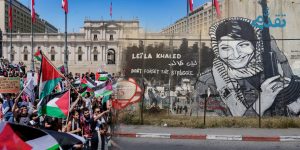
Palestinian resistance is no longer merely a regional issue—it has become a global symbol of dignity in the face of colonialism and imperial hegemony.
The historical backdrop plays a crucial role in shaping the current situation of genocide and attempted erasure of memory, countered by Palestinian grassroots resistance and global protests aimed at halting it. This context spans centuries of capitalism and violence perpetrated by Anglo-Saxon and Western colonial forces, as well as the Israeli military.
One way to interpret the 20th and 21st centuries is through the emergence of African and Asian national liberation movements amidst ongoing colonial projects, particularly during the Great European War (1914–1945). The 1950s and 1960s witnessed a revolution in global energy systems.
Oil became the dominant fossil fuel, surpassing coal and other sources. Known as “black gold,” it propelled post-war capitalism due to its energy density, chemical flexibility, and ease of transport, fueling technological and industrial development. These energy shifts, alongside the rise of U.S. power, shifted the geopolitical center toward Afro-Eurasia.
Simultaneously, colonial powers declined, and new or emerging organizations were created to push major decolonization efforts in Asia and Africa during the latter half of the 20th century—amid rivalry between socialist and capitalist blocs, and efforts by non-aligned nations like at the Bandung Conference (1955).
Global transformations continued through revolutions, uprisings, and the emergence of new states during the Cold War. Some aligned with the Soviet Union, others with the U.S., Britain, or France, each undergoing unique paths of decolonization.
Critical historical moments challenge Eurocentric narratives when viewed from other geographies: the Berlin Conference (1884), 1960s decolonization waves, India’s independence (1947), the Chinese Revolution (1949), and the Russian Revolution (1917). These events helped shape the modern century.
The 1949 Chinese Revolution paved the way for 21st-century transformations, followed by the Korean War (1950–1953) and Vietnam’s resistance wars (1960–1975). In Latin America, revolutions such as Mexico’s (1910–1917) and Cuba’s (1959) fundamentally altered national trajectories and global consciousness.
These cultural and civilizational specificities reject oversimplified narratives like the “clash of civilizations” or Francis Fukuyama’s “end of history.”
From a Global South perspective, where major decolonization took place, Cold War binaries don’t apply. These were not “underdeveloped” nations but societies with deep Afro-Asian historical legacies beyond Western nation-state models.
The expulsion and persecution of Palestinians awaken historical traumas from transatlantic slavery and colonial genocide. The goal is to erase a people and their land in service of imperial interests—especially those led by the U.S.—via control over oil, gas, and Gaza’s coastline.
For decades, directed media narratives have placed Palestinians and Arabs at the center of a “clash of civilizations,” branding them as “terrorists” under the guise of the “War on Terror,” thereby stripping their resistance of political legitimacy.
Hamas, as a political, social, and armed movement with Islamic roots, represents resistance against colonial occupation. Many of its leaders are descendants of refugees expelled in 1948 and assassinated by Israel.
This crisis cannot be understood without analyzing U.S. support for Israel. Since 2013–2014, and especially after February 2022, U.S. power has relatively declined, particularly in Eurasia.
Conflicts like the war in Ukraine intersect with Israeli escalations in Syria, Yemen, and Iran. The Middle East conflict is tied to global trade routes and regional power rivalries among Saudi Arabia, Turkey, and Iran. The BRICS+ alliance (Brazil, Russia, India, China, South Africa, plus Egypt, Iran, Ethiopia, UAE, Indonesia) plays a growing role, especially South Africa.
Today, Palestinian resistance stands as a global symbol of dignity. Gaza, the open-air prison, represents the moral and political core of Global South struggles—where modern crises converge: neoliberal disintegration, military imperialism, structural racism, and ecological collapse.
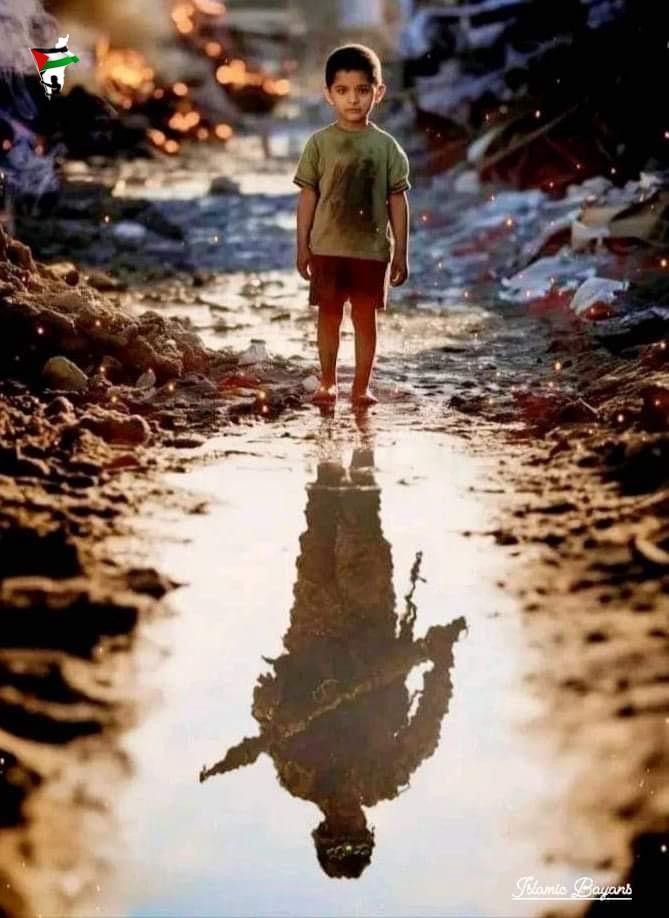
Images from Gaza—destroyed hospitals, maimed children, devastated neighborhoods—reveal not only war crimes but also the hypocrisy of the global liberal order. The UN, EU, and Western media have failed to stop the killing machine.
In contrast, a new internationalist current is rising from below, linking Palestine to broader struggles across Asia, Africa, and Latin America.
The “Axis of Resistance,” though not a formal alliance like NATO, plays a key role in Palestine. Comprised of nations and movements across West Asia, Africa, and the Global South, it’s united not by bureaucracy, but by shared histories of resistance: Vietnam, Algeria, Cuba, Iran, Yemen—all resisted Western domination.
Despite attempts to dismantle it—like the war in Syria, Qassem Soleimani’s assassination (2020), or targeting leaders like Haniyeh (2024), Nasrallah, and Sinwar—resistance endures due to its grassroots, decentralized nature. Yemen’s Ansar Allah is a prime example of an actor capable of challenging Israel militarily, viewed as an imperial outpost in Afro-Eurasia.
This resistance axis doesn’t aim merely to defend land—it seeks to thwart the U.S.-Israeli project of “managed chaos,” aimed at dividing the region and reinforcing foreign military presence. In this scheme, Palestine is not just a victim—it is the strategic fault line preventing full execution. Yet, the latest escalations in Gaza, Lebanon, and Syria pose severe challenges.
Latin America also plays a critical role. Governments like Javier Milei’s in Argentina, beholden to Israel’s agenda, show contempt for international law and attack critical culture—demonstrating that Palestine’s struggle also unfolds in Buenos Aires, Lima, and Bogotá. Defending Palestine means defending our universities, unions, and social rights.
Thus, it is essential to build bridges between our resistances. The streets of Caracas, the neighborhoods of São Paulo, the classrooms of Havana, and indigenous movements in Bolivia—all morally and politically align with Gaza. This new internationalism is not proclaimed at summits, but forged through solidarity, political education, decolonial thought, and cultural rebellion.
Palestine is not alone. Nor are we. Taking a stand today is not merely a moral act—it is a global political stance.
Gaza challenges us, for it is where the future of the world is being drawn: a future of technological barbarism and racial supremacy, or one rooted in dignity, justice, and self-determination.
In the early days of Israel’s unprecedented attacks on Gaza, Iran’s Supreme Leader Ayatollah Ali Khamenei stated in October 2023: “Israel’s claim to victimhood is one of the biggest lies of this century.”
That phrase redirected the media storm surrounding the “Al-Aqsa Flood” and awakened dormant consciences.
Today, Israel’s fabricated victimhood lies buried beneath the rubble of martyred children, grieving mothers, and destroyed hospitals.
In the face of this historic injustice, voices from across the world—from Tehran and Beirut to Baghdad, from Johannesburg to Buenos Aires, from Havana to Amsterdam—resound with one cry: No to genocide.
Today, every person who believes in justice—regardless of faith, belief, or nationality—stands with the Palestinian people.
This cross-cultural unity proves that resistance is not merely a political option, but an ethical response to the civilizational decline of our era.
Israel’s actions contradict the teachings of true Judaism and the moral foundations of liberalism. Authentic Judaism celebrates justice, compassion, and the sanctity of life. It justifies neither the killing of children nor the siege of hospitals. Modern moral philosophy—especially Immanuel Kant’s—asserts that humans must never be treated as mere means, but as ends in themselves.
Kant wrote: “Human beings must always be treated as ends in themselves, never merely as means to an end.”
What we witness in Gaza is the use of human beings as tools for political and racial extortion.
John Locke, the founding father of political liberalism, emphasized three natural rights: “life, liberty, and property.” Rights denied not just to Palestinians, but to all humanity by Israel.
To Tel Aviv’s leaders, we ask: By what principle, philosophy, or conscience do you continue these massacres?
You reject UN resolutions, ignore ICJ rulings, and disdain global public opinion.
Today, Israel doesn’t just violate human rights—it embodies a moral breakdown in the international order.
Co-authors
• Martin Martinelli: PhD in Social Sciences, Professor of History at Universidad Nacional del Litoral, Argentina.
• Peiman Salehi: Iranian political philosopher & international affairs analyst
 Peiman Salehi – Political Analyst & Writer
Leave a comment